The premise of @PythagoreanDays:
Each day I post a derivation of the square root of the day's ordinal date using right triangles, using whole numbers and focusing on simplicity.
The ordinal date is a number between 1 and 366 corresponding to the number of days since the beginning of the current calendar year, including the current day. February 2 is the 33rd day of the year, so its ordinal date is 33.
- - -
The Pythagorean theorem pertains to the three sides of a right triangle. It states that the area of the square whose side is the hypotenuse (the side opposite the right angle) is equal to the sum of the areas of the squares on the other two sides.
For a right triangle with a hypotenuse of length c and the other two sides of lengths a and b, the following equation is true: a²+b²=c²
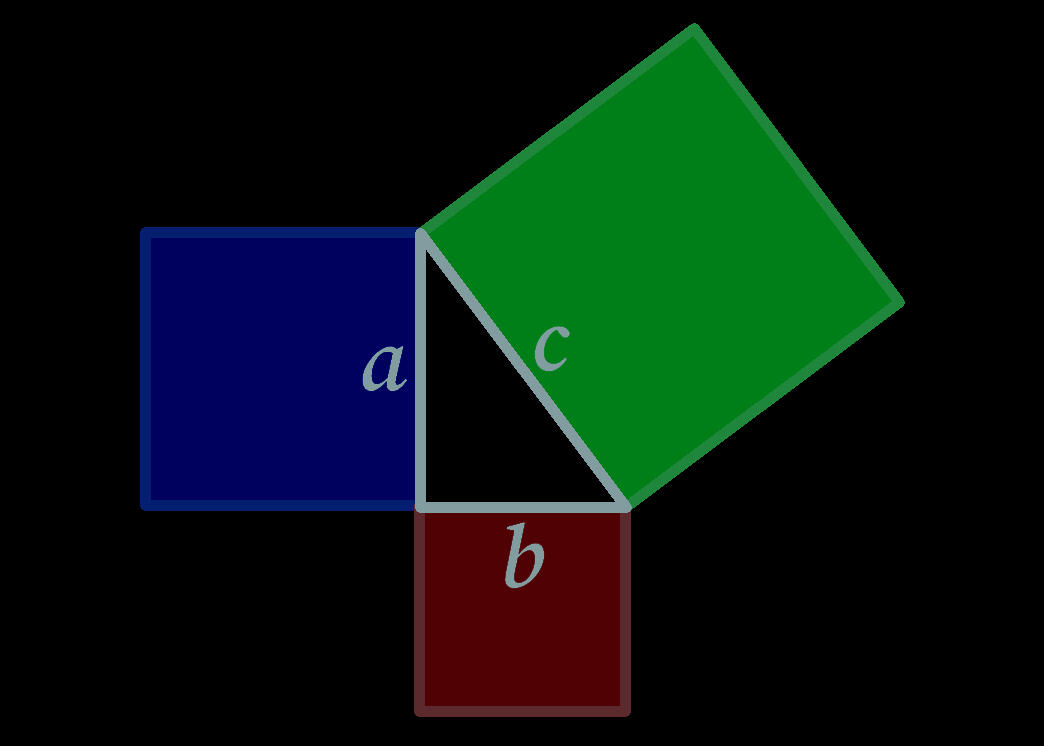
The premise of this account is to derive a line segment with a length equal to the square root of the day's ordinal date, using geometric constructions involving right triangles.
The limitations and capabilities for this undertaking:
We can draw a line segment of any integer length.
We can form a right (90°) angle to any line segment at its endpoint.
We can draw a circle with a radius of any integer length, centered at any point.
We cannot draw any other line segment or angle except by connecting other points.
- - -
There are four possible situations discovered while analyzing the problem.
Some numbers are perfect squares. Drawing a segment whose length is equal to the square root of a perfect square is trivial. As mentioned, we are allowed to draw line segments of any integer length. Because this case is trivial, we will use one of the other methods in these cases.
Second, some numbers can be written as the sum of two squares. For values between 1 and 366, no squares above 19² will need to be used, so the table of possibilities is finite and relatively small. Excluding duplicates, 121 of the 366 dates appear here.
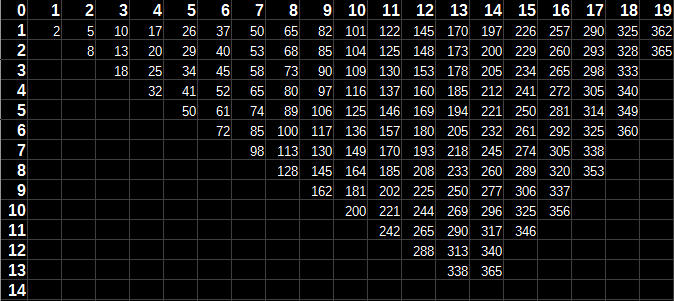
For this case, constructing the segment whose length is equal to the square root of the ordinal date is simple: draw a segment of length a; draw a segment of length b starting at one endpoint, at a right angle; connect the two remaining endpoints.
Third, some numbers can be written as the difference of two squares. This table is larger, though only a small portion contains results between 1 and 366.
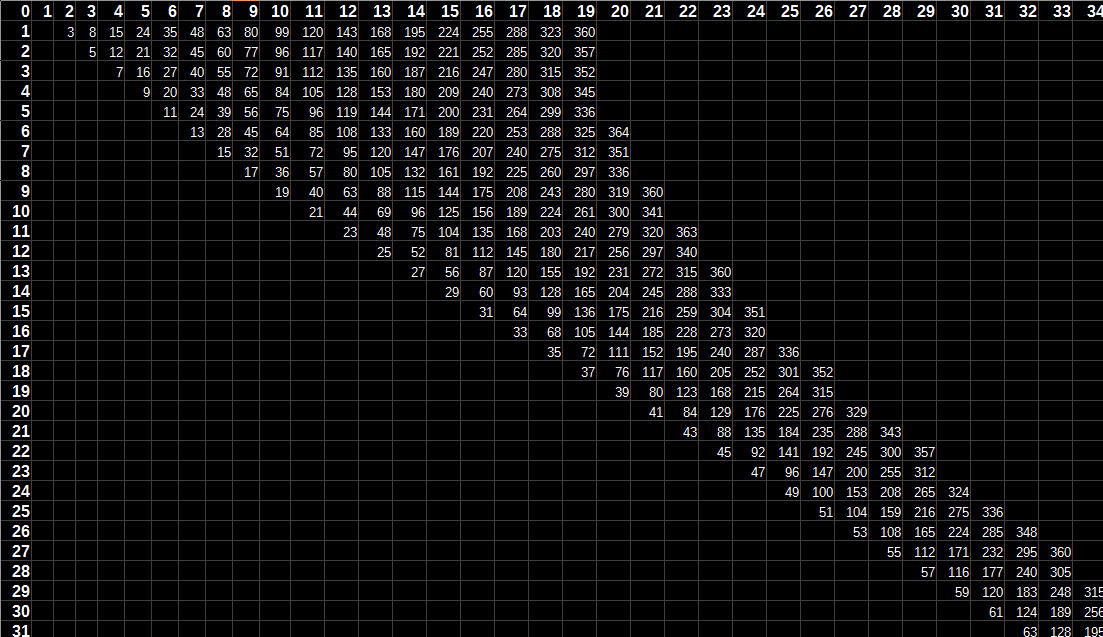
(The relevant portion of the table extends further down and to the right, tapering off to a fine line with a final entry of 183²-182²=365.)
For this case, drawing our desired segment requires drawing a right triangle where the length of the hypotenuse is equal to the square root of the larger square and one of the other sides is equal in length to the square root of the smaller square number.
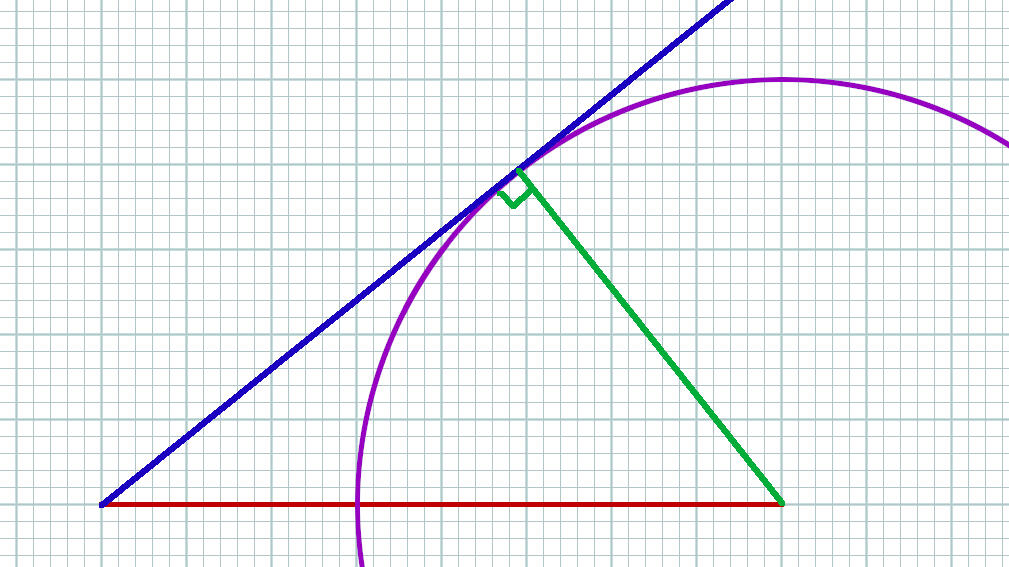
To make this construction, draw a line segment of length c. Then draw a circle of radius a centered at one endpoint. Finally, draw a line which passes through the other endpoint of the segment and forms a tangent to the circle (touching it at a single point).
When a radius is drawn to a point of tangency, the angle formed between the radius and the tangent is always a right angle. Thus we are forming a right triangle.
Cases 2 and 3 cover the majority of ordinal dates, but there are many numbers which are neither the sum of positive squared integers nor the difference between squared integers. Numbers as low as 1, 4 and 6, as well as 366, fall into this category.
For this fourth case, we must first construct an intermediate segment using the methods in cases 2 and 3, then use that segment as one side of a right triangle with an integer length for another side.
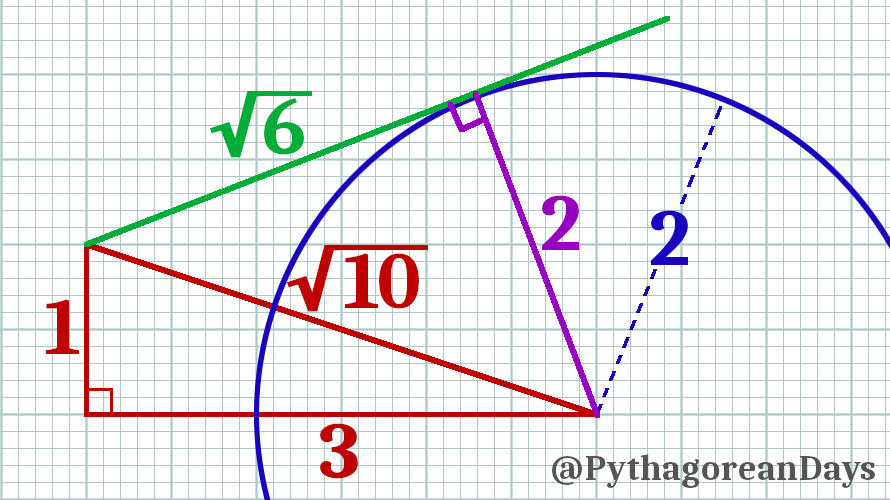
In the illustration above, we are trying to construct a segment of length √6. 3²+1²-2²=6. So first, we construct a right triangle with sides of lengths 3 and 1. The hypotenuse will have a length of √10. Now we will draw a circle with a radius of 2, centered at one end of the hypotenuse. If we draw the tangent to this circle that passes through the other endpoint of the hypotenuse, then the radius of the circle which touches the tangent point, we will have drawn another right triangle with a hypotenuse of length √10 and one side of length 2. According to the Pythagorean theorem, if the length of the other side is n, then n²+2²=(√10)², so n is √6.
(That said, 2²+1²+1² also equals 6, and that's what we'll use on the 6th of January.)
As long as we can write the number as either x²+y²+z², x²+y²-z² or x²-y²-z², where x, y and z are integers, we can construct the segment of the desired length. As of the time this is being written, every date has worked.
(If it did not, we would be forced to use an additional intermediate step. We should never need to go beyond this; Lagrange's theorem states that that every positive integer can be expressed as the sum of the squares of four integers. But three squares should always be enough if we can add and subtract.
- - -
For this project, I will try to use the simplest, neatest method to derive the square root of the ordinal date. Some dates have multiple possibilities; I may choose to illustrate more than one solution.
Generally, I will prioritize the sum of squares, giving preference to solution whose largest number is smallest (e.g., 5²+5² will rank higher than 7²+1²). Next will be the difference of squares; as before, 4²-1² will be preferred to 8²-7².
If three squares are needed, a single solution will be given; it may not be the optimal solution, as I am searching for these by hand.
Here be dragons...
If you're not interested in some of the deeper theory and analysis involved in this project, you can end your journey here. Otherwise...
- - -
Looking at the larger picture, is there a method for finding whether a number is the difference of two squares? I used a table for this project, but in analyzing the table, I found some patterns.
If the number is odd and greater than 1, it can always be written as the difference of two positive squares. If you write the odd number in the form 2n+1, this is equivalent to (n+1)²-n². Example: 45 is 2×22+1, and 23²-22²=45.
For odd multiples of 3 greater than 9, a solution with smaller numbers than this can be found. If you write the odd number in the form 6n+9, this is equivalent to (n+3)²-n². Example: 45 is 6×6+9, and 9²-6²=45.
For odd multiples of 5 greater than 25, if you write the odd number in the form 10n+25, this is equivalent to (n+5)²-n². Example: 45 is 10×2+25, and 7²-2²=45.
This pattern continues and can be generalized: For odd multiples of x greater than x², if you write the odd number in the form 2xn+x², this is equivalent to (n+x)²-n². (x must be odd; there are no odd multiples of even numbers.)
So all odd numbers greater than 1 can be written as the difference of two positive squares, some more elegantly than others. What about even numbers?
Well, if the number is a multiple of 4 greater than 4, if you write the odd number in the form 4n+4, this is equivalent to (n+2)²-n². Example: 48 is 4×11+4, and 13²-11²=48.
For multiples of 8 greater than 16, a solution with smaller numbers than this can be found. If you write the odd number in the form 8n+16, this is equivalent to (n+4)²-n². Example: 48 is 8×4+16, and 8²-4²=48.
For multiples of 12 greater than 36, if you write the odd number in the form 12n+36, this is equivalent to (n+6)²-n². Example: 45 is 12×1+36, and 7²-1²=48.
This pattern continues and can be generalized: When x is even, for multiples of 2x greater than x², if you write the number in the form 2xn+x², this is equivalent to (n+x)²-n².
Example: 7168 is 2^10×7, so it's a multiple of 128 (2×64) greater than 64² (4096). (x=64.) Writing 7168 in the form 128n+4096 gives us 128×24+4096 (so n is 24), which is equivalent to (24+64)²-24². Indeed, 88² is 7744, and 7744-576 equals 7168.
So if the hypotenuse of a right triangle is 88 and another side is 24, the remaining side will have a length of √7168.
If we look at a table of differences of squares, it becomes apparent that all the entries are either odd or multiples of 4. (That is to say, if x is in the table, x (mod 4) is 0, 1 or 3, but never 2.
Why? Even squares are always divisible by 4, and odd squares are always 1 greater than a multiple of 4. If you write the odd square as (2n+1)², this expands to 4n²+4n+1, and both 4n² and 4n are divisible by 4.
So, since squares are either 0 (mod 4) if even or 1 (mod 4) if odd:
even² (mod 4)-even² (mod 4) = 0-0 = 0 (mod 4)
odd² (mod 4)-odd² (mod 4) = 1-1 = 0 (mod 4)
odd² (mod 4)-even² (mod 4) = 1-0 = 1 (mod 4)
even² (mod 4)-odd² (mod 4) = 0-1 = 3 (mod 4)
A result of 2 (mod 4) is impossible.
Determining whether a number can be written as a sum of two squares is a bit trickier. A positive integer n can be represented as the sum of two squares, n=x²+y², if and only if every prime divisor p≡3 mod 4 of n occurs with even exponent.
In more straightforward text, look at the prime factorization. Each prime divisor which equals 3 mod 4 (so 3, 7, 11, 19, 23, 31, etc.) must occur an even number of times. (0 is even.)
Let's look at some examples.
147 = 3·7²
3 appears an odd number of times. 147 is not a sum of two squares.
4840 = 2³·5·11²
The only prime divisor equaling 3 mod 4 is 11, and it appears an even number of times. 4840 is a sum of two squares. 22²+66²=4840.
68600 = 2³·5²·7³
7 appears an odd number of times. 68600 is not a sum of two squares.
- - -
For some deeper insight:
Fermat Sum of Two Squares Calculator
Dietrich Burde, How to determine whether a number can be written as a sum of two squares?, URL (version: 2014-05-09)
Can every integer be written as the sum or difference of three squares? Yes.
Gerry Myerson, Representation of integers by ternary quadratic form $x^2+y^2-z^2$, URL (version: 2014-08-12)